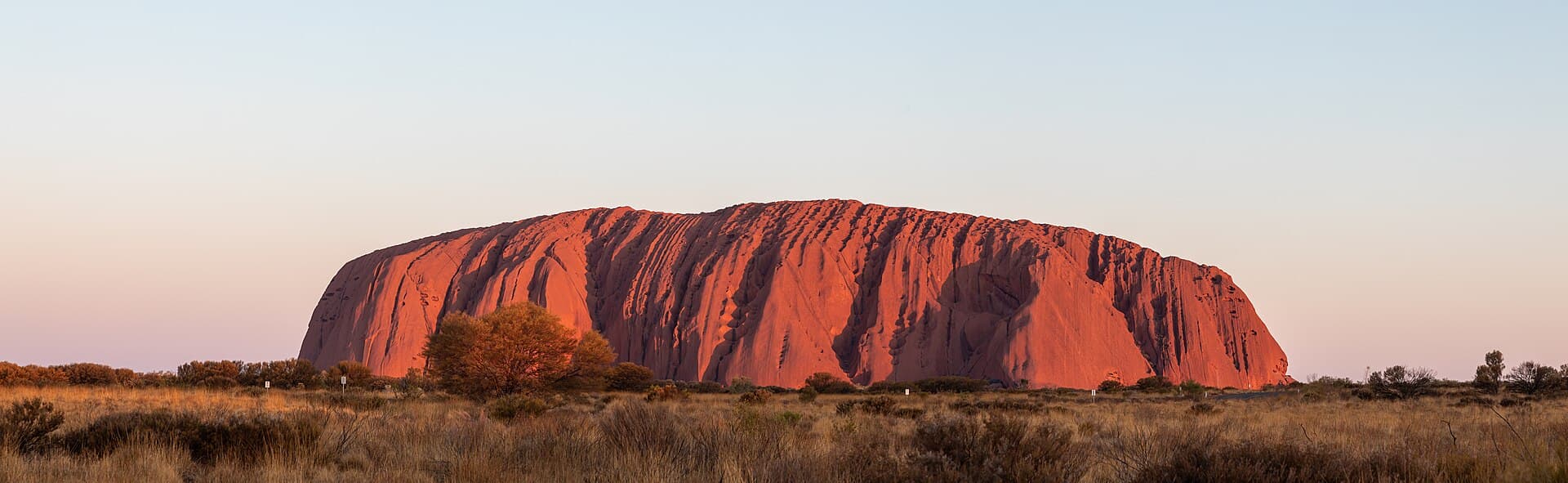
Red Centre · Northern Territory
Uluru — a closed-climb monolith that needs days, not a dusk
Cooler months, a parks pass, and a base at Yulara or Alice Springs. The climb has been closed since 26 October 2019.
- Typical park time
- 2–3 days
- Kinder months
- Apr–Sep
- Climb since 2019
- Closed
- Alice to Yulara
- ~450 km
Uluru is worth visiting if you can give it two or three park days in the cooler months and treat it as Anangu country, not a sunset pull-in. A single dusk photograph is possible. It is not the visit people mean.
Definition
Uluru. A sandstone monolith in Uluru–Kata Tjuta National Park, jointly managed by Anangu Traditional Owners and Parks Australia. The climb is closed. The park pass is official, not optional folklore.
What you are visiting
Uluru is the better-known formation in Uluru–Kata Tjuta National Park, on the lands of the Anangu people in the Northern Territory. It is jointly managed with Parks Australia. The park is not a council lookout. You buy the official parks pass, stay on marked tracks and viewing areas, and follow photography restrictions at culturally sensitive sites.
The climb closed on 26 October 2019. There is no “quiet day” exception. The visit now is a base walk or a shorter marked section, sunrise and sunset viewing areas, the cultural centre, and a separate day for Kata Tjuta’s Walpa Gorge or Valley of the Winds when conditions allow.
Is Uluru worth it?
It is worth it when the trip is built around the park. Fly into Connellan Airport (Ayers Rock / Yulara) or drive the sealed road from Alice Springs — roughly 450 kilometres, a half-day, not a dusk dash after a long-haul landing. Sleep at Yulara (the resort village outside the park) or treat Alice as a town bookend. Two park days covers a sunset, a sunrise, and either a long base section or Kata Tjuta. Three days is the visit that includes both formations without stacking them on the same heat.
It is less worth it in January if you expected long midday walks, or if the only slot on the calendar is a four-hour coach photo stop between two unrelated flights. In that case, keep the money for a harbour city and come back when the dates match.
How a visit actually runs
Mornings start early. Sunrise viewing areas fill in cooler peak months. Carry water even when the air feels kind. Midday is for the cultural centre, a rest, or a short indoor plan — not a hero walk. Late afternoon is the second outdoor window. Parks staff and signs will close walks in extreme heat. Believe them.
The Mala and Kuniya walks interpret specific stories; they are not generic nature trails. Mutitjulu Waterhole is a short marked walk with cultural constraints. The full base circuit is about ten kilometres. You do not have to complete it to have been there.
Bases and the Alice question
Yulara is the practical park base: short transfers, the only nearby beds, and a village that exists because the park does. Alice Springs is a real town with its own ranges, desert park and flights. It is not “next door”. Putting Alice and Uluru on the same afternoon is how people arrive dehydrated and late. A seven-day Red Centre itinerary treats them as separate chapters.
Kings Canyon (Watarrka) is the usual third act on a sealed-road week. It is not inside Uluru–Kata Tjuta National Park. Do not schedule the rim walk after a late Uluru breakfast.
Passes, culture, and what we will not invent
Buy the Parks Australia pass for Uluru–Kata Tjuta. We do not publish the current dollar figure. Confirm hours, shuttle or car-park rules, and drone bans on the official site. Anangu ask visitors not to climb and to respect no-photograph zones. That is not optional etiquette.
Uluru is not a day trip from Sydney or Melbourne. It is not interchangeable with Kakadu. If you are choosing the Centre against the reef, read Uluru vs the Great Barrier Reef.
A day on Anangu country, written slowly
Arrive at the park with water already in the car. The cultural centre is the correct indoor start: it explains why the climb closed, why some sites are not for photographs, and why “Ayers Rock” is a colonial caption rather than the name you should lead with. From there, the day’s outdoor window is morning or late afternoon. Midday in the Centre is not a character test. It is a heat injury waiting for people who treated the rock like a city lookout.
The Mala Walk interprets a specific story along the base. Kuniya Walk does the same toward Mutitjulu. Rangers and Anangu guides, when you join a licensed tour, will tell you more than a self-drive pamphlet. We do not rank those tours. We do tell you to stay on the marked surface. Vegetation here is not a shortcut.
Sunset viewing areas are busy in July. That is not a reason to stand on a forbidden dune. Sunrise is colder and earlier than holiday brains expect. If you only have one outdoor window, pick it and protect it. If you have three park days, you can give Uluru two lights and Kata Tjuta one morning without turning the week into a checklist.
What “worth it” actually means
Worth it means you remember the scale of the sandstone, the quiet of a marked track, and the fact that you did not climb. It means you bought the pass, carried water, and did not treat Anangu requests as optional vibe. It does not mean you collected a drone reel or a summit story from before 2019.
Not worth it, for some travellers, is a 40-degree week with a four-hour coach stop. That is an honest outcome. Come in May or August instead. The rock will still be there. The park rules will still be there. Your knees will thank you.
Linking the Centre without lying
Kings Canyon is the usual third act on a sealed week. Alice Springs is a town with its own West MacDonnell ranges if you have slack. Kakadu is not on this road. The reef is not on this road. Sydney Harbour is not a day trip. When your whiteboard has all four names, you do not have a plan. You have a flight search.
Read the park companion page for pass mechanics. Read the Red Centre itinerary for a seven-day shape. Read the Territory hub when someone says “NT” and means both climates at once.
What to drop from a Centre whiteboard
Drop climbing. The track closed on 26 October 2019; there is no quiet-day exception. Drop a four-hour coach photo stop between unrelated flights if you expected the visit people mean. Drop driving Alice to Yulara at dusk after a long-haul landing — roughly 450 kilometres of sealed highway is a half-day, not a transfer. Drop stapling Kakadu onto this ticket. Drop stapling a reef boat onto a three-night Yulara stay. Drop midday hero walks in January. Drop drones as a casual hobby. Drop photographing restricted sites.
Keep the Parks Australia pass. Keep water already in the car. Keep the cultural centre as the indoor start. Keep sunrise or late afternoon as the outdoor window. Keep Kata Tjuta as its own morning on the park companion. Keep Kings Canyon as the usual third act on a seven-day sealed circuit if you have the week. Keep the Territory hub when the whiteboard still says “do the NT”.
Verify with Parks Australia
Hours, heat closures, shuttle or car-park rules, and cultural restrictions live on the official Uluru–Kata Tjuta pages at parksaustralia.gov.au. When this guide and that site disagree, the park wins. We do not publish live prices. We do not rank tours. We do not sell the pass. If you are choosing the Centre against the reef, read Uluru vs the Great Barrier Reef. If the whole country is still a ten-day list, read first trip, 10 days.
Best time of year to visit Uluru
| Compare | Cooler months (about April–September) | Hot months (about October–March) |
|---|---|---|
| Daytime heat | Walkable mornings and late afternoons on marked tracks. | Heat is a safety limit. Many walks become early-only or unwise. |
| Crowds | School holidays and July still fill sunrise spots. | Fewer coaches some weeks; more heat risk. |
| What to book first | Park pass, beds at Yulara, a sunrise or base-walk plan. | The same — plus a honest look at whether you should wait. |
Questions
What travellers always ask
Yes, if you give it two or three park days and visit in cooler months. A single sunset from a car park is a photograph, not the visit.
Give the rock its own days
Pair Uluru with Kata Tjuta and, if you have a week, Kings Canyon. Do not glue Kakadu onto the same short ticket without a flight and a season check.